
Events
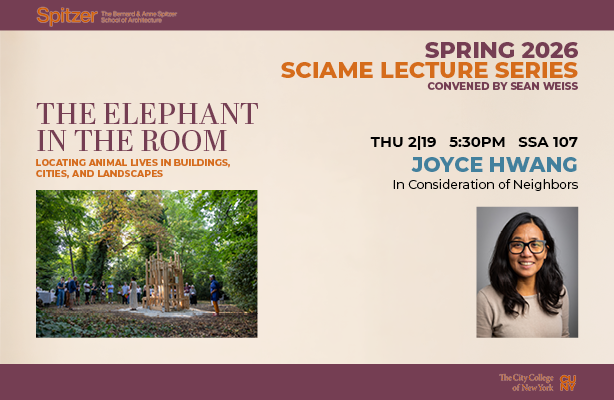
Spring 2026 Sciame Lecture Series: Joyce Hwang
In Consideration of Neighbors
Thursday, Feb 19, 2026
5:30 pm - 7:00 pm
Sciame Auditorium (Room 107)
141 Convent Avenue
New York, NY 10031
Please RSVP
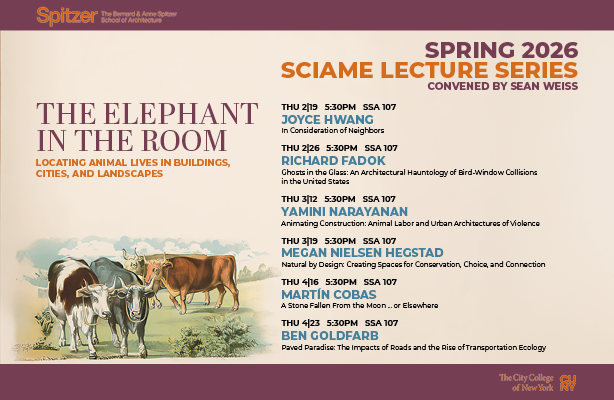
This in-person lecture is part of the Spring 2026 Sciame Lecture Series, "The Elephant in the Room: Locating Animal Lives in Buildings, Cities, and Landscapes."
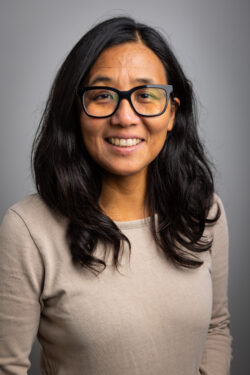
Joyce Hwang, FAIA, NOMA, (she/her) is a Professor of Architecture at the University at Buffalo SUNY, Director of Ants of the Prairie, partner at Double Happiness, and a core organizer for Dark Matter U. For nearly two decades, she has been developing projects that incorporate wildlife habitats into constructed environments. She is a recipient of the WOJR/Civitella Ranieri Architecture Prize, Exhibit Columbus University Research Design Fellowship, Architectural League Emerging Voices Award, MacDowell Fellowship, and NYFA/NYSCA Fellowship, among other awards. Her work has been featured by a range of platforms, including MoMA, Brooklyn Botanic Garden, Matadero Madrid, and the Venice Architecture Biennale. Based in Buffalo, she is a registered architect in New York State.
"In Consideration of Neighbors": The lecture will reflect on the trajectory of Joyce Hwang’s research and practice to discuss how we might learn from our living environment in engaged and empathic ways. Considering our more-than-human neighbors and communities, her work explores how architecture can proactively integrate multispecies habitats into our shared built environment, focusing on ways in which architecture can address not only the significant crisis of biodiversity loss, but also advocate for multispecies kinship and climate justice.
In this presentation, Joyce will discuss her roles as both a design practitioner and educator, exploring collaborations with nonprofit organizations, academic institutions, public agencies, local businesses, and interdisciplinary partners – including Brooklyn Botanic Garden, the Bentway Conservancy, Civitella Ranieri, Matadero Madrid, City as Living Lab (CaLL), Artpark Western New York, Silo City Buffalo, Landmark Columbus, the Australian Capital Territory’s Department of Parks and Conservation, Australian National University (ANU), and University at Buffalo, among others.
Suggested Readings:
Living Among Pests (written in 2013, published in Volume Magazine, republished in Next Nature)
Headshot photo credit: Douglas Levere.
"The Elephant in the Room: Locating Animal Lives in Buildings, Cities, and Landscapes" takes its title from the expression “the elephant in the room,” which originates in the Russian author Ivan Krylov’s 1814 fable “The Inquisitive Man.” In the story, a visitor to a natural history museum becomes so enthralled with countless “birds and beasts” that he overlooks the largest of them all: a colossal elephant. As the expression gained currency, any reference to real animals gave way to metaphorical ones. The spring 2026 Sciame lecture series takes the idiom literally by addressing the common failure to notice all animals in the built environment. In the lecture series, scholars, designers, thinkers, and activists cast light on imagining, designing, and sharing buildings, cities, and landscapes with other species.
Making space for animals in the built environment often requires diverting attention away from our human perspective and desires, thus troubling our own anthropocentrism and claims about human exceptionalism. More often than not, the built environment creates antagonistic, if not deadly, conditions for animals. Ballooning construction campaigns, invasive resource extraction for building materials, and hermetically sealed structures have all decimated animal habitats and killed countless animals. Given the planetary threats of diminishing biodiversity, the climate crisis, and health emergencies, recentering animal lives and human-animal relationships in the built environment is critical to the survival of all animal life.
All lectures are free, open to the public, and held in the Bernard and Anne Spitzer School of Architecture Sciame Auditorium. For live captioning, ASL interpretation, or access requests, please contact ssadean@ccny.cuny.edu.
This lecture series is made possible by the Spitzer Architecture Fund and the generous support of Frank Sciame ’74, CEO of Sciame Construction.
Export as: