
Events
Fall 2025 Sciame Lecture Series: Adi Shamir-Baron
-

Fall 2025 Sciame Lecture Series
-

Fall 2025 Sciame Lecture Series
-
Fall 2025 Sciame Lecture Series
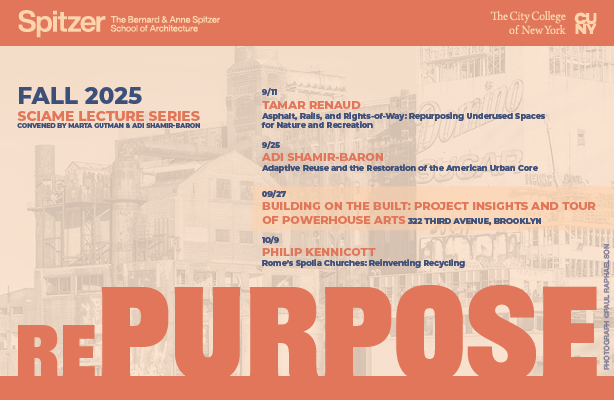
Adaptive Reuse and the Restoration of the American Urban Core
Thursday, Sep 25, 2025
5:30 pm - 7:00 pm
Sciame Auditorium (Room 107)
141 Convent Avenue
New York, NY 10031

This in-person lecture is part of the Fall 2025 Sciame Lecture Series, "rePURPOSE."
Adi Shamir-Baron is Vice President of Development Design at McCormack Baron Salazar, a leading national housing development company founded in 1973, with a portfolio of 188 projects in 45 cities and more than 26,000 high quality homes for families, seniors, and veterans. With expertise in historic preservation, sustainable building design, and real estate finance, she works with joint venture partners and local community groups to analyze investment opportunities and design strategies focused on the development of mixed-income and mixed-use initiatives in urban communities across the country.
"Adaptive Reuse and the Restoration of the American Urban Core" will present an overview of McCormack Baron’s affordable housing development work in the US, centering on people and opportunity, with buildings as the medium. Over the decades, the company has preserved and adapted dozens of historic properties, providing the catalytic investment that sparks renewed interest in disinvested urban cores, particularly in Rust Belt states. The projects demonstrate the power of preservation and adaptive reuse not only to retain a city’s historic fabric, but to restore, renew, and in the process, energize communities.
Suggested Reading: Hand, J., Brash, A., & Orff, K. (2011). Civic Life in the Making - Adi Shamir. In Gateway: visions for an urban national park. Princeton Architectural Press.
"rePURPOSE" centers on the practice of adaptive reuse in the built environment. Repurposing, embedded in historical patterns of city building and for the most part discarded in the modern movement, is undergoing a remarkable renaissance. The lecture series invites architects, planners, developers, advocates, and engineers to present the technologies, designs, economic incentives, and policy changes that are needed to advance a substantively renewed and at-scale program of repurposing in New York and other global cities. The reuse of old structures is not a new idea. After the fall of the Roman Empire, for example, the Colosseum was repurposed for housing and workshops during the medieval period. Although reuse is understood as a convention that both requires and imposes minimal impact, rePURPOSE shines light on how the methodology might not be entirely benign, how it might in fact have real impact, and the ways in which it challenges and would necessarily disrupt the very conventions with which we typically assume it is aligned.
Of special, although not exclusive, interest is unpacking the relationship of repurposing to the climate crisis. Might historic preservation sit at the center of technical innovation? Are all older buildings valuable as climate mitigation assets, or will new uses, such as data storage in old buildings, undermine the LCA embodied carbon savings achieved? What rules, laws, and incentives are needed to sustain innovative approaches to meaningful reuse, and to what extent will a complete reform of preservation regulations and zoning frameworks be required?
The Fall 2025 Sciame lecture series will address the profound potential inherent in giving new life to old structures; employing adaptive reuse methodologies to impact environmental, economic, and cultural conditions by reducing waste and carbon emissions, lowering costs and raising property values, maintaining historical character, and preserving local identity.
All lectures are free, open to the public, and held in the Bernard and Anne Spitzer School of Architecture Sciame Auditorium. For live captioning, ASL interpretation, or access requests, please contact [email protected].
This lecture series is made possible by the Spitzer Architecture Fund and the generous support of Frank Sciame ’74, CEO of Sciame Construction.
(Photograph ©Paul Raphaelson)
Export as: