
Events
Spring 2026 Sciame Lecture Series: Ben Goldfarb
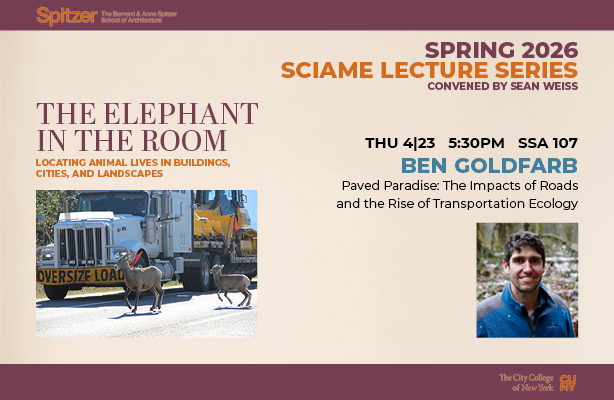
Paved Paradise: The Impacts of Roads and the Rise of Transportation Ecology
Thursday, Apr 23, 2026
5:30 pm - 7:00 pm
Sciame Auditorium (Room 107)
141 Convent Avenue
New York, NY 10031
Please RSVP
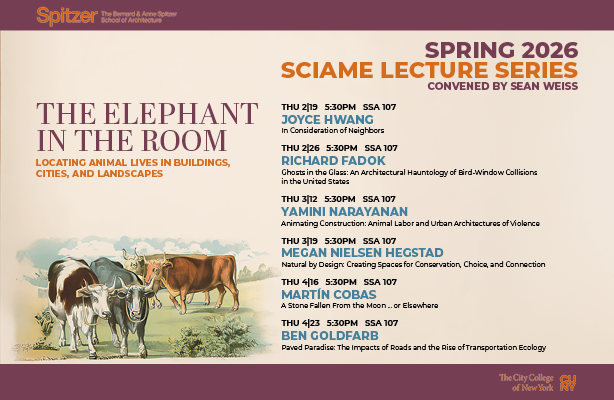
This in-person lecture is part of the Spring 2026 Sciame Lecture Series, "The Elephant in the Room: Locating Animal Lives in Buildings, Cities, and Landscapes."
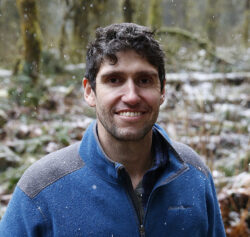
Ben Goldfarb (he/him) is an environmental journalist whose work has appeared in National Geographic, the Atlantic, Smithsonian Magazine, the New Yorker, and many other publications. His most recent book, Crossings: How Road Ecology Is Shaping the Future of Our Planet, was named one of the best books of 2023 by the New York Times and received the Rachel Carson Award for Excellence in Environmental Writing and the Banff Book Competition’s Grand Prize. His previous book, Eager: The Surprising, Secret Life of Beavers and Why They Matter, won the PEN/E.O. Wilson Literary Science Writing Award. He lives in Colorado with his wife, his daughter, and his dog, Kit — which is, of course, what you call a baby beaver.
"Paved Paradise: The Impacts of Roads and the Rise of Transportation Ecology": Some 40 million miles of roadways encircle the earth, yet we tend to regard them only as infrastructure for human convenience. While roads are so ubiquitous they’re practically invisible to us, wild animals experience them as alien forces of death and disruption. More than a million animals are killed by cars each day in the U.S. alone; creatures from antelope to salmon are losing their ability to migrate in search of food and mates; and the very noise of traffic chases songbirds from vast swaths of habitat. Today, road ecologists are seeking to blunt that destruction through innovative solutions. Conservationists are building bridges for California’s mountain lions and tunnels for English toads, engineers are deconstructing the labyrinth of logging roads that web national forests, and community organizers are working to undo the havoc highways have wreaked upon American cities. In his talk, Ben Goldfarb will discuss the ecological harms wrought by transportation and the movement to redress them — and how we can create a better, safer world for all living beings.
Suggested Reading: How Roadkill Became an Environmental Disaster, Ben Goldfarb, The Atlantic, 2019.
"The Elephant in the Room: Locating Animal Lives in Buildings, Cities, and Landscapes" takes its title from the expression “the elephant in the room,” which originates in the Russian author Ivan Krylov’s 1814 fable “The Inquisitive Man.” In the story, a visitor to a natural history museum becomes so enthralled with countless “birds and beasts” that he overlooks the largest of them all: a colossal elephant. As the expression gained currency, any reference to real animals gave way to metaphorical ones. The spring 2026 Sciame lecture series takes the idiom literally by addressing the common failure to notice all animals in the built environment. In the lecture series, scholars, designers, thinkers, and activists cast light on imagining, designing, and sharing buildings, cities, and landscapes with other species.
Making space for animals in the built environment often requires diverting attention away from our human perspective and desires, thus troubling our own anthropocentrism and claims about human exceptionalism. More often than not, the built environment creates antagonistic, if not deadly, conditions for animals. Ballooning construction campaigns, invasive resource extraction for building materials, and hermetically sealed structures have all decimated animal habitats and killed countless animals. Given the planetary threats of diminishing biodiversity, the climate crisis, and health emergencies, recentering animal lives and human-animal relationships in the built environment is critical to the survival of all animal life.
All lectures are free, open to the public, and held in the Bernard and Anne Spitzer School of Architecture Sciame Auditorium. For live captioning, ASL interpretation, or access requests, please contact ssadean@ccny.cuny.edu.
This lecture series is made possible by the Spitzer Architecture Fund and the generous support of Frank Sciame ’74, CEO of Sciame Construction.
Export as: