
Events
Spring 2026 Sciame Lecture Series: Martín Cobas
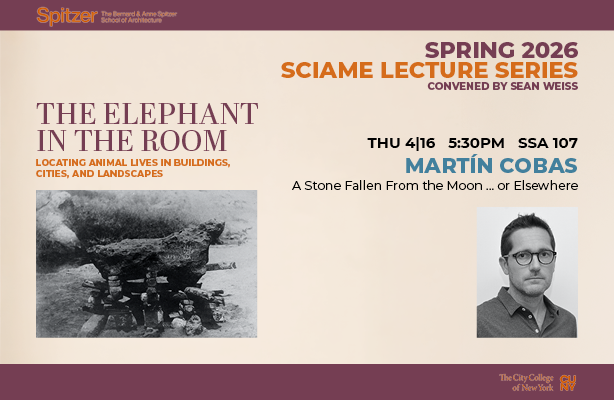
A Stone Fallen From the Moon … or Elsewhere
Thursday, Apr 16, 2026
5:30 pm - 7:00 pm
Sciame Auditorium (Room 107)
141 Convent Avenue
New York, NY 10031

Please RSVP
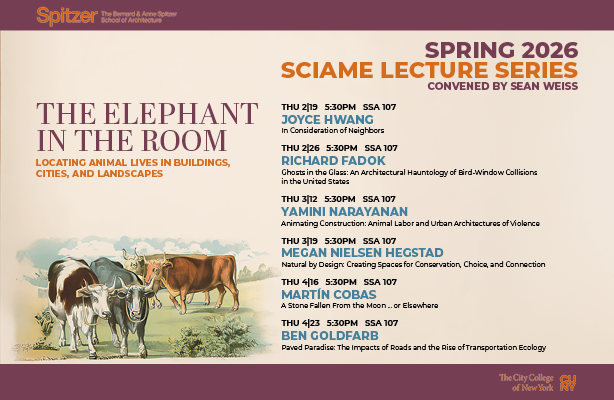
This in-person lecture is part of the Spring 2026 Sciame Lecture Series, "The Elephant in the Room: Locating Animal Lives in Buildings, Cities, and Landscapes."
Martín Cobas is Professor of Architectural History and Design and Co-director of the Ph.D. Program in Architecture at the School of Architecture, Design, and Urbanism (FADU) of the Universidad de la República (Montevideo), where he previously served as Chair of the Department of Architectural History and as Associate Dean of Graduate Studies. He has practiced with Fábrica de Paisaje (co-founded in 2007), lectured internationally, and had his scholarship published in specialized journals and edited volumes. Cobas is a founding editor of Vitruvia and is currently working on two book manuscripts. He holds a professional degree in Architecture from FADU-Udelar, a Master's in Design Studies (with Distinction) from Harvard GSD, and an M.A. and Ph.D. in the History and Theory of Architecture from Princeton University. He was the Fall 2025 Robertson Visiting Professor at the UVA School of Architecture.
"A Stone Fallen From the Moon … or Elsewhere": The rarefied mineral constitution of a meteorite — yet also epiphytic life, or a life-threatening “epidemic” unfolding in the arrière-pays. This talk examines the entangled lives (and afterlifes) of certain object-subjects in late nineteenth- and early twentieth-century Brazil, tracing their institutional trajectories and the ways in which they mediated between wondrous exoticism and emergent “global” scientific regimes. The remarkable story of the Bendegó Meteorite serves as the protagonist in a broader narrative of modernization, scientific systematization, material geopolitics, asymmetric cosmogonies, and the emergence of new interspecies ecologies. Rather than a passive specimen— condemned to a foreign “deep time” and an extra-telluric provenance — the meteorite, I argue, becomes a micro-ontological diplomat. What would it mean to locate the modern in the “outside” of modernity — in the Amazônia, the Pantanal, or the Sertão? What forms of agency do nonhuman entities exert in shaping our existential domains? How do they mediate a world of ontological unease? At the center of this exploration is the concept of the creaturely. Creaturing, then, becomes a method to reveal and theorize hitherto unexplored alter-ecologies, while foreshadowing lessons we might draw from the “other” in imagining (and designing) worlds of beyond-the-human camaraderie. Not quite a creature, the meteorite nonetheless opens a space of radical alterity from which to explore its vital intimations.
Suggested Readings: Cobas, Martín. “Pig,” in The Architect and the Animal, edited by Kostas Tsiambaos (Cambridge: The MIT Press, 2025): 70-75 and Cobas, Martín. “(Anti)venom Ecologies: Three or More Issues Concerning the Serpent, edited by Santiago del Hierro, Johanna Just, and Ciro Miguel, gta papers, Amazônía (2025): 67-83.
"The Elephant in the Room: Locating Animal Lives in Buildings, Cities, and Landscapes" takes its title from the expression “the elephant in the room,” which originates in the Russian author Ivan Krylov’s 1814 fable “The Inquisitive Man.” In the story, a visitor to a natural history museum becomes so enthralled with countless “birds and beasts” that he overlooks the largest of them all: a colossal elephant. As the expression gained currency, any reference to real animals gave way to metaphorical ones. The spring 2026 Sciame lecture series takes the idiom literally by addressing the common failure to notice all animals in the built environment. In the lecture series, scholars, designers, thinkers, and activists cast light on imagining, designing, and sharing buildings, cities, and landscapes with other species.
Making space for animals in the built environment often requires diverting attention away from our human perspective and desires, thus troubling our own anthropocentrism and claims about human exceptionalism. More often than not, the built environment creates antagonistic, if not deadly, conditions for animals. Ballooning construction campaigns, invasive resource extraction for building materials, and hermetically sealed structures have all decimated animal habitats and killed countless animals. Given the planetary threats of diminishing biodiversity, the climate crisis, and health emergencies, recentering animal lives and human-animal relationships in the built environment is critical to the survival of all animal life.
All lectures are free, open to the public, and held in the Bernard and Anne Spitzer School of Architecture Sciame Auditorium. For live captioning, ASL interpretation, or access requests, please contact ssadean@ccny.cuny.edu.
This lecture series is made possible by the Spitzer Architecture Fund and the generous support of Frank Sciame ’74, CEO of Sciame Construction.
Export as: