
Events
Spring 2026 Sciame Lecture Series: Megan Nielsen Hegstad
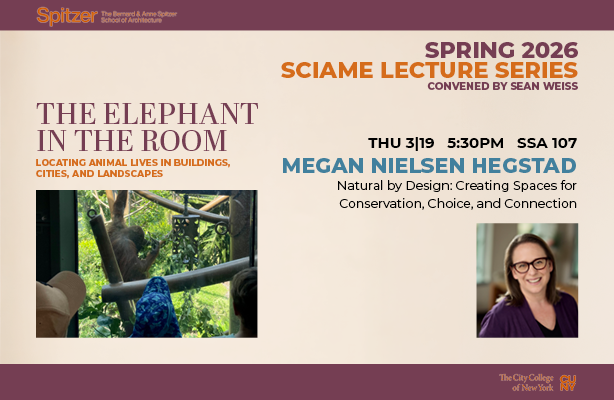
Natural by Design: Creating Spaces for Conservation, Choice, and Connection
Thursday, Mar 19, 2026
5:30 pm - 7:00 pm
Sciame Auditorium (Room 107)
141 Convent Avenue
New York, NY 10031

Please RSVP
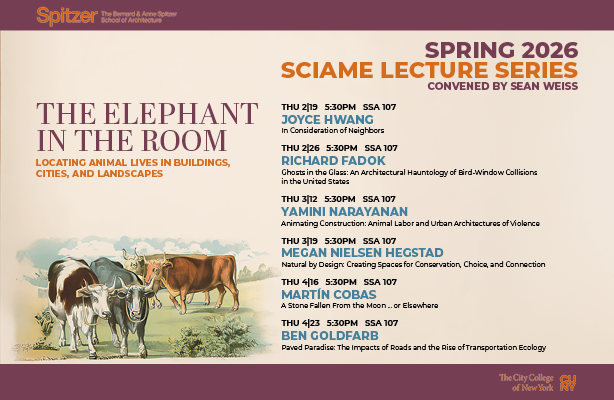
This in-person lecture is part of the Spring 2026 Sciame Lecture Series, "The Elephant in the Room: Locating Animal Lives in Buildings, Cities, and Landscapes."
Megan Nielsen Hegstad (she/her): With a passion for people, animals, and art, Megan is a registered architect and exhibit designer with 23 years of experience in creating complex zoo and aquarium and guest experience projects that are unforgettable and transformative. She has worked with over 4 dozen conservation organizations around the world, on 140+ projects. Megan is a strategic leader guiding multi-disciplinary teams with creativity, empathy, and organizational strength. She walks the walk by visiting 85 AZA-accredited institutions and 25 other zoos and aquariums, volunteering with AIA, AZA, TEA, ZANE, and IAAPA, and mentoring as an AZA Creating Successful Exhibits course instructor.
"Natural by Design: Creating Spaces for Conservation, Choice, and Connection": How can design connect the built and natural environment to create places that are meaningful not just for an individual, but for community, animals, and plants? In this talk, we’ll explore the evolution of design for animals and what lessons about conservation, choice, and connection can be learned from modern zoo and aquarium design to inform a holistic approach to any project. Forward-thinking zoos and aquariums not only conserve animals within their care but also contribute to field conservation and are vital community hubs. Fulfilling this mission begins with place. Design has the power to foster conservation of resources and provide a framework for the conservation of both flora and fauna. Understanding human and animal psychology and behavior allows for the integration of autonomy through choice and control, which improves animal and human well-being. Starting the design process by developing message and experience goals provides guideposts that inspire moments of connection between humans and animals and indelible memories for the families and friends who visit. Together, designing with conservation, choice, and connection in mind can elevate form to purpose to create not just a building but a place within the context of a broader natural system and organizational mission.
Suggested Listening and Reading: BRPH Podcast: Optimizing Zoo Programming and Design and BRPH Designing for Neurodiversity: How Can Zoos, Aquariums and Attractions Incorporate Sensory Inclusion to Welcome All?
"The Elephant in the Room: Locating Animal Lives in Buildings, Cities, and Landscapes" takes its title from the expression “the elephant in the room,” which originates in the Russian author Ivan Krylov’s 1814 fable “The Inquisitive Man.” In the story, a visitor to a natural history museum becomes so enthralled with countless “birds and beasts” that he overlooks the largest of them all: a colossal elephant. As the expression gained currency, any reference to real animals gave way to metaphorical ones. The spring 2026 Sciame lecture series takes the idiom literally by addressing the common failure to notice all animals in the built environment. In the lecture series, scholars, designers, thinkers, and activists cast light on imagining, designing, and sharing buildings, cities, and landscapes with other species.
Making space for animals in the built environment often requires diverting attention away from our human perspective and desires, thus troubling our own anthropocentrism and claims about human exceptionalism. More often than not, the built environment creates antagonistic, if not deadly, conditions for animals. Ballooning construction campaigns, invasive resource extraction for building materials, and hermetically sealed structures have all decimated animal habitats and killed countless animals. Given the planetary threats of diminishing biodiversity, the climate crisis, and health emergencies, recentering animal lives and human-animal relationships in the built environment is critical to the survival of all animal life.
All lectures are free, open to the public, and held in the Bernard and Anne Spitzer School of Architecture Sciame Auditorium. For live captioning, ASL interpretation, or access requests, please contact ssadean@ccny.cuny.edu.
This lecture series is made possible by the Spitzer Architecture Fund and the generous support of Frank Sciame ’74, CEO of Sciame Construction.
Export as: